Thursday, July 30, 2009

Review: Off the Beaten Path by Readers Digest

genre: travel guide

If you are a road tripper like me, YOU WILL LOVE THIS BOOK. I have two kinds of travel books I like: small city guides that fit in my pocket that I take around with me and books that give me ideas of trips to plan. These second books tend to be bigger and get left at home, but they are indispensable for travel nuts like me. Off the Beaten Path is the second kind of book. It's a hard bound, coffee-table-book-quality with brilliant pictures. It's categorized by state with a MAP at the beginning showing where each site is located! It's like heaven for nerds like me!!

The sites listed for each state aren't the usual run of the mill stuff, either. There are all different kinds of ideas - not just historical or outdoorsy or wacky. It's all those things are more with websites and phone numbers listed for each entry.

Really, I am a fan. And I've had more than one friend sit on my couch, find this book and agree with me - it's a fantastic resource.

Buy it here or at your local bookstore :)

Tuesday, July 28, 2009

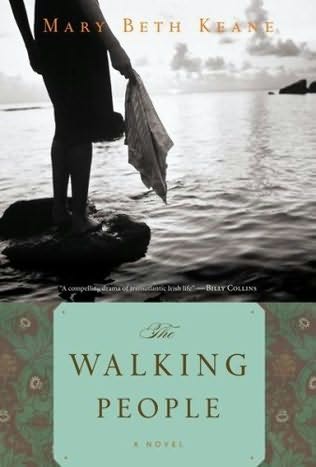
Review: The Walking People by Mary Beth Keane

genre: fiction
review: 4/5

While I've read a host of books about early 1900s immigration, The Walking People is a story about a different generation of immigrants -the Irish who came to America in the early 60s. Greta's family lives in a tiny, nearly abandoned town in Western Ireland, near the sea and not much else. Life during Greta's childhood was much the same way it had been for hundreds of years, they were warmed by a turf fire and ate by candlelight. 'Tinkers" or "Traveling People" walked the highways and made a living by doing odd jobs, staying in camps along the way. Greta's early interactions with these Traveling People will reverberate and result in relationships that last her lifetime.

The Walking People is about, first and foremost, family. What we do for them and what we inadvertently do to them - and not just the children we raise, but the family we were raised by. Greta's very close relationship with her mother and sister, and how that relationship changed, influenced so much of the way she lived her life. I was sometimes frustrated by the choices she made while at the same time I was sympathetic to why she made those choices. She's an interesting character, this Greta, naive and yet wise - thoughtful and stubborn, and I think Keane did an excellent job of rounding out all her characters. I think I liked reading about the family Greta grew up in more than I liked reading about the family she raised, but maybe that's because I just liked reading about life in Ireland more.

One unique thing about this novel that I appreciated, was its use of time periods. Typically, I am annoyed when we start at the end of a story and then move backwards, because I feel like it rips out the footing from under the plot to already know how the story ended. But somehow, in the Walking People, this devise just completely intrigued me. Even though I knew that certain people would end up being together, I was thrilled to discover how it all happened. So three cheers for that.

I think that for a debut novel, The Walking People is pretty darn amazing, even if the end left me feeling somewhat hanging. If you can overlook the sometimes harsh language, I think you'll appreciate this story that takes you from one side of the Atlantic to the other, down beneath the streets of New York City and back, and the beautiful language leaves you pining for an Irish home that you never even had.

Friday, July 24, 2009

Review: A Girl's Guide to Modern European Philosophy by Charlotte Greig

genre: chick lit
Rating: 2/5

As a 22 year old philosophy student at Sussex, Susannah’s life revolves around her studies and her relationship with her older boyfriend Jason. When a boy in her course catches her fancy, she’s suddenly pulled in two different directions, but instead of making a decision and choosing one over the other , she floats along and lets her philosophical musings convince her that making no decision is a decision in and of itself. When the situation hits the fan and Susannah finally has to look into herself and decide what she wants, she once again turns to modern day philosophers to work through what she really wants for herself and her future.

There are things about this book that I liked. I did like that you get an introduction to philosophy and that you can see it applied , I also liked that Susannah grew up a bit throughout the course of the book. The writing style alternated between light chick-lit and deep philosophy, which was interesting. Beyond flowing hair for the men and disco, the book just didn't give me much of a sense of the 1970s - with the exception of the feminist debate, especially over the issue of abortion, which felt very realistic and gave me a sense for how hard it would have been to figure out your role as a woman during that time.

However, for me, the plot was too much based in Susannah’s bedroom life. The pace of the novel was a bit slow. Beyond that, I wanted her to stand on her own feet more and even at the end when she finally made a choice, I still felt like she was being self-absorbed, which was frustrating for me. I think my main problem can be boiled down to the fact that I just could not relate very well to any of the characters, despite my appreciation for their struggles.

If you’d like to read a different take on this one, please visit one of these other sites:

The Literate Housewife
Book Pleasures

Thursday, July 23, 2009

Guest Review: Confessions of Trauma Junkie by Sherry Jones Mayo

Thanks so much to guest reviewer Lauren Cahoon for writing the following review. Lauren is currently a Nursing Student.

genre: non-fiction

Emergency Service Workers: ordinary people doing extraordinary things. Sherry shares experiences and insight that only an individual who has worked as a Paramedic, Emergency Room Nurse, and critical incident de-briefer could. In each of the four parts of the book, a different aspect of the life of an emergency service worker was portrayed: arriving on the scene of an accident, getting in an accident and allowing others to serve you just as you serve so many, having an injured child placed with trust in your arms, going home at the end of the day and reliving events time and again. Sherry did not shy away from sharing the heartache, fear, anxiety, frustration, faith, and hope that one experiences while on the job.

As a nursing student this book was captivating, it allowed me enter into the heart and mind of a professional who has been doing what I have wanted to do for years. Though I often like a story (one that has a beginning, middle, and end) this compilation of experiences from those who spend their days trying to help, and in some cases save, anyone that comes through the door, it gave me an insight that a novel could not have. I finished the last page with an increased understanding of and appreciation for the dedicated individuals who give so much of themselves to their patients.

Monday, July 20, 2009

review: Sister Wife Shelley Hrdlitschka

genre: ya
rating: 4/5

You can probably guess the plot by the title - Sister Wife is the story of a young teenager who was raised in a polygamist sect, named Unity. 15 year old Celeste has always let her mind wander more than it should. And although she knows that listening to her father and The Prophet, and obeying what they say, is the way to eternal life, she still struggles with what she is asked to do - have pure thoughts and prepare to be a sister wife. Well, she's not really asked to do those things. She's told. And as much as she wants to be free to think her own thoughts, even more she wants to do what God and her father want her to do.

But this story isn't only about Celeste. It's also about other young people that live in Unity - and we even get to read part of the story from their viewpoint, which I really liked. The author does a fine job of helping the reader see what a very structured and conformist society Celeste lived in, and how very, very hard it would be for someone to choose to leave. The conflict these teenagers feel is astounding - love for family, love for God, but a recognition that they are lacking any kind of independence, what teenagers crave the most.

All in all, I really liked it. It wasn't as gripping for me as it maybe could have been and the ending wrapped up a bit too nicely for me to completely believe it, but that doesn't mean I didn't appreciate that things ended the way they did. Certainly, if you are interested in the subject, it shouldn't be missed.

review: Baking Cakes in Kigali by Gaile Parkin

genre: fiction
rating: 5/5

This beautiful African story, set in post-genocide Rwanda, is not only compellingly and simply told - but also touches on much of what makes us truly happy in life.

Angel is a Tanzanian living in Rwanda with her husband and the five grandchildren she's raising. Her claim to fame in the town of Kigali is her extraordinary and unique cakes. The process of designing the perfect cake for her customers lets her into their lives - they share their stories. Through these stories we see in many people a remarkable ability to adapt and to survive, to change and grow and find goodness wherever they are. We also see great depravity and horror as those who managed to live through the genocide begin to put heir lives and their country back together, with the help of people from many nations.

I loved so much about this book - I loved Angel's listening ear and her desire to look at things truthfully. I loved how the plot revolved around her cakes, those scrumptious creations designed for so many different reason and for so many different kinds of people. And the people! A cross section of humanity - UN workers, refugees, professors, volunteers, orphans, chauffeurs, stay-at-home moms and poor AIDS patients that are trying to gain skills to make a living. We meet so much of Africa and her people - as well as those from near and far who legitimately desire to help Rwanda come back to life. The educated and illiterate are living side by side - Hutus and Tutsis are choosing to look beyond their past to a larger-than-life future. I loved the depth of this charming story.

Read it.

Tuesday, July 14, 2009

word verification

Yeah, I know it drives some of you readers crazy, but the word verification is back on. How many comments full of Chinese characters does one blogger have to put up with?

Monday, July 13, 2009

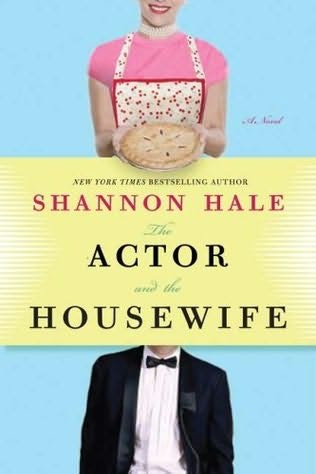
Review: The Actor and the Housewife by Shannon Hale


genre: adult fiction/chick-lit (sorta)
rating: 4/5

When the pregnant and mom-of-three Becky Jack goes to L.A. for the chance of a lifetime, she is randomly introduced to her movie star crush: Felix Callahan. This happenchance meeting leads to a witty and clever friendship that slowly allows Felix to have a small place in Becky's heart. It's a small space, because her life is so full of her loving husband and her kids and her church and her responsibilities and she really loves the life she chose. Right?

But he keeps being in her thoughts and Becky has a lot to sort through. Her husband Mike plays a vital role, obviously, in Becky's efforts to make such a strange best-friendship work. As the story progresses, life becomes less "Mormon Housewife" and more, well, complicated. First and foremost, Becky cares about her relationships and her religion - and making all of these things mesh together in the perfect way is the crux of this book.

I don't know why this book was an enigma for me - for some reason I just never completely believed it. Don't get me wrong, I couldn't put it down - it had me laugh out loud in a couple different places and I found Becky and Felix as characters highly amusing and complex. I liked the comfortable and familiar writing style and I liked reading a book that took place in a world I know well. And though sometimes her portrayal of said world was a bit too cliche for my taste, it fully deserves its four stars. But, maybe it's because I know the "Mormon Housewife" world so well that I just couldn't stretch my imagination quite as far as I needed to so that I could fully appreciate the love stories. I don't think it's Hale's writing - I think it's me. It's totally worth you trying it for yourself.

Sunday, July 12, 2009

Review: Why Darwin Matters:The Case Against Intelligent Design by Michael Shermer

book 3 out of 5 for the Non-Fiction Five Challenge
genre: science/non-fiction
rating: 4/5

I have come to the conclusion that the subtitle should actually be the title of this book. Sometimes I felt like I was in court and Intelligent Design was the defendant - Shermer's purpose was to lay down the facts regarding evolution is such a way as to explain why Intelligent Design is a scientific impossibility. Or, the fact that, in his opinion, Intelligent Design is not scientific at all.

I rarely read books that are so thoroughly scientific. I'm not going to lie: sometimes I had to skim over the most in-depth parts about RNA and mitochondria and the more nitty gritty aspects of evolutionary theory. But there was much that was interesting about studies that have been done and anecdotal stories about evolutionary science - these were very accessibly written. I feel like I now have a sense for what both sides of the Evolution vs. Intelligent Design debate assert and that I'm more able to have an informed discussion about the topic.

I liked how the book was set-up, the chapter headings and sub-headings really guided my reading and often answered questions that came up as I read, especially this: is it possible to reconcile a faith in God as a supreme being/creator and knowledge of evolutionary theory? He goes into this in depth, obviously, as he separates the theory of evolution from theological discourse. I appreciated that he acknowledged that yes, it is totally possible to be reconciled to both - but I also felt, and this bothered me, that he tended to be condescending regarding those who DID believe in Intelligent Design. Actually, the whole tone of the book felt a bit condescending to me - and even though he presents an excellent case and I don't even disagree with his point - I just wish he'd been less patronizing.

This book got me thinking, that's for sure. I can't pretend this is the perfect summer beach read or that everyone will want to pick it up, but it helped me use my brain for a while, got me to sort through how I feel about a multitude of issues and for the most part, it did entertain me. So, take from that what you will.

Tuesday, July 7, 2009

Book Tour: A Worthy Legacy by Tomi

Last May I reviewed the book A Worthy Legacy and now it's on tour!! This book is a collection of thoughts and ideas that were given to the author by her grandfather on his deathbed. My full review is here, but I wanted to include my final thoughts:
What I am appreciating, now that I am letting his thoughts mull around in my mind, is that he and I, two completely different people who have led absolutely different lives on opposite sides of this planet - we believe the same things about how to live a good life. This elderly gentleman who grew up in a Nigerian village wanted to teach his children the same things that I want to teach mine. His simple words never startled me or surprised me - the writing is not lyrical or jubilant or complex. You merely come away from the book knowing that Tomi's grandfather left this life knowing what was worth caring about - and that if we read closely, we might be tempted to look for that same knowledge ourselves.
Please take a look at some of the other reviews out there! The next stop in the tour is at Lost in Books.

Monday, July 6, 2009

Review: The Tempest by William Shakespeare

rating:4/5

Fuss about it all you want, I agree that he's not easy to understand, but the guy WAS a genius. I've been reading one play per year (about all I can handle :) for 4 years now - and while The Tempest isn't my favorite of the ones I've read, it's still full of the vivid language and intricate ideas that I've come to expect - a real commentary on the human condition.

What makes this one a bit different is that our main character, Prospero the unfairly de-throned former duke of Milan, is a magician. He is stranded on a deserted island with his beautiful daughter Miranda and not only does he have a special book that helps him to do magic, he also has an indentured "spirit" named Ariel (yeah, I thought it was a girl at first, but it's a boy :) who helps him to control the seas and create a tempest to bring his former enemies right to his virtual doorstep.

Of course there is love. Of course there are whisperings of treachery. There are even disappearing banquet tables - and about a thousand references to Greek literature that I have to be fine with not understanding. My enjoyment of Shakespeare comes from my acquired ability to glean as much as I can (making sure I understand the general plot) and then letting the gory details just slide on by. I know I could potentially obsess over every choice of words, but I choose not to. Perhaps I am shallow, but I just appreciate what I can and glory in those phrases that speak to me. Phrases like:
The rarer action is
In virtue than in vengeance.

My library
Was dukedom large enough.

What's past is prologue.

We are such stuff as dreams are made on.

Misery acquaints a man with strange bedfellows.

Be not afeard; the isle is full of noises,
Sounds and sweet airs, that give delight and hurt not.
Sometimes a thousand twangling instruments
Will hum about mine ears, and sometime voices
That, if I then had waked after long sleep,
Will make me sleep again: and then, in dreaming,
The clouds methought would open and show riches
Ready to drop upon me that, when I waked,
I cried to dream again.
Twangling! What a great word and what a beautiful image! I read along as I watched a dvd of the play this time, and listening to the words being spoke as I read them really helped things make more sense. Sometimes, though, the watching did me a disservice - especially in the case of Ariel, who in my version wore a tiny little less-than-a-loincloth and acted extremely effeminate, which distracted me from the action if I was watching the screen instead of my book :)

**this could be a spoiler, I guess**Prospero is an interesting sort of double character - first with his God-complex and then becoming all forgiving in the second half. I can see, though, that this story is all about journeys - over the sea, over the island, from death to life, from sorrow to joy. Maybe Prospero just had a journey of his own - and I think the fact that all these things end happily (i.e. no one dying or killing anyone in the final scenes) is what makes this a "comedy." I never laughed, mind you, but I liked that there were chances for people to atone and find peace. For whatever reason, this one just did not grab me the same way others have - but it was still worth reading (watching).

Saturday, July 4, 2009

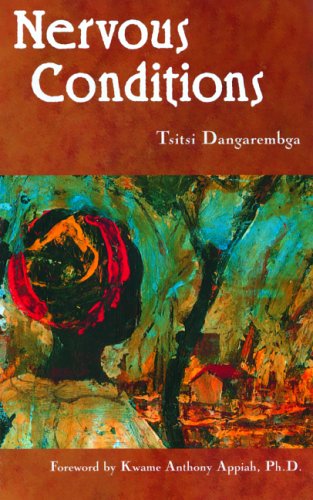
review: Nervous Conditions by Tsitsi Dangarembga

book 8 of 10 for the Orbis Terrarum 2009 challenge
book 6 of 12 for the Young Adult Challenge 2009

genre: young adult
rating: 4/5

Tambu, raised on a homestead in the back country of Zimbabwe (then a colony of Britain, called Rhodesia) has very little to engage her young mind. As she grows and her desires for education and knowledge increase, she finds that she is constantly fighting against two factors: the fact that she is female and the fact that she is African.

And while she loves her parents and can find some beauty in her tiring and off-the-land life on the homestead, what she truly wants to go to school. A string of circumstances enable her to travel to a mission and attend the mission school where her uncle is the headmaster. At school, Tambu's horizons expand by leaps and bounds, not only because of new experiences but especially because of her relationship with her cousin, Nyasha, who spent her much of her early childhood in England. Nyasha's world view is much more questioning and cynical and she forces Tambu to ask hard questions about what she wants and why she wants it.

This is a true coming of age story - a young girl learning about herself, discovering not only the grander world around her, but also the more intimate workings of her immediate family. The fact that all this is happening on an Rhodesian farm, within a strictly patriarchal culture that is so unfamiliar to me and yet, so beautifully described - makes it all the better. I found myself as frustrated as she was with the constraints and assumptions she (and other women in the story) had to deal with because she was female. Nervous Conditions is full to the brim with topics to discuss: colonialism, racism, feminism, assimilation, "primitive" culture vs. "progressive" culture, even mental health. All those deep issues tossed around in a story of a girl and her cousin, trying to figure out their place in a society that was set up to keep African women as small as possible.

I really enjoyed reading this one, but I can't call it a page turner, really. I read because Dangarembga has a wonderful way with words and because I loved spending some time in a place so foreign. The plot moves forward, but isn't gripping - it's more like a ride down the river of Tumba's life, occasionally there is a major upset, but mostly we are just gliding along with her as she sorts through the things she sees and hears. Though I didn't fly through it, I enjoyed the ride.