Tuesday, May 26, 2009

Review: Gift From the Sea by Anne Morrow Lindbergh

book 4 of 5 for the Classics Challenge 09
book 2 of 5 for the Non-Fiction Five Challenge 09
genre: non-fiction
rating: 5/5

I remember seeing this book upon my mother's shelf when I was a child. The title intrigued me, I always wanted to find pictures of the sea inside and I wondered what sort of gift the sea could give. There weren't any pictures and the text didn't interest me, so I would always put it back a little disappointed.

Now that I am a woman and a mother, I found great wisdom in the text and I know now the gifts that the sea gave to Lindbergh, intangible and yet so vibrant and applicable. The sea and a few small precious beach treasures help her to look deeper into herself, to find what she can do to make her life a more simple and profound thing. She wants to be able to move with the flow of life, like the tide, ever willing to change and adapt, willing to let something new become the norm until some other new stage comes along.

Her writing is more than lyrical, it is profound and effortless. She sets the struggles in our lives out on a blank slate and reconciles them with the necessity of living in the here and now seeing those struggles in the context of a greater purpose. I loved her discussions of the ebb and flow of marriage and other relationships and how desperately important it is for each individual to find time alone to ponder and reflect, to fill up our wells once again so that, especially as mothers, we have enough to give to those around us that need us. And with that thought, I will end this with a quote:
Now, instead of planting our solitude with our own dream blossoms, we choke the space with continuous music, chatter, and companionship to which we do not even listen. It is simply there to fill the vacuum. When the noise stops there is no inner music to take its place. We must re-learn to be alone.

Sunday, May 24, 2009

Review: The Chrysalids by John Wyndham

book 3 of 4 for the It's the End of the World Challenge II
genre: post-apocalyptic/science fiction
rating: 3/5

The premise of this book is so promising: a great "Tribulation" has swept the earth and genetic mutations are rampant. Many small communities have vague legends of the "Old People" who once lived and their highly religious societies have defined a "human" in very specific terms. Five fingers. Five toes. Two eyes. And if a person deviates from this strict definition of a pure human, they are a menace to society and not tolerated.

Our main character, David, is raised in this fundamentalist society and as he grows up he begins to see that not all deviations are as visible as others. And as he learns more about the place that the world has become, he begins to question the truths that he'd always been taught.

There are deep thoughts in this book: what makes a person human? What kinds of secrets are okay to keep and what are the consequences when trust is broken? What are the results of intolerance in society? I can see why it is a book that would be discussed in English classes, there is much to discuss. What did not thrill me was the writing itself. The characters felt like they were painted with vague brushstrokes instead of with interesting details, only at the very end did I feel like I started to care about them. The writing was just not...literary. It was like listening to a Joe Schmoe tell me a story at the dinner table, it didn't ever really grab my interest.

I am aware that a lot of hard-core science fiction fans would like to skewer me, and that's fine. It's a classic, I keep reading in every review, and I don't know why I just missed it with this one. A bit disappointing, but, not horrible. It really is an interesting idea and I liked where the plot took the story, I just was a bit bored on the way there. If you are a true devotee of the science fiction genre, this early classic is probably still worth reading.

Monday, May 18, 2009

review: Fire by Kristin Cashore

book 3 for the Once Upon a Time III Challenge
genre: young adult fantasy
rating: 5/5

In Fire, our story takes us beyond the seven kingdoms of Graceling, to an eastern land that is teetering on the edge of war. The connections between Fire and Graceling are very few and center upon one character in particular, who is a crucial element to both plots.

The book Fire centers on the character of Fire - a girl who is born compellingly beautiful and with the ability to read and mold the minds of those around her. The beauty that makes her irresistible is both a danger and an asset and the imminent war becomes of the utmost importance to Fire as secrets are revealed and her abilities give her a crucial role among the King and his family.

Could I put this book down? Of course not. I think Cashore's writing is even tighter this time around, especially the dialogue. The plot is more political, more militarily focused with as much intrigue as Graceling and with characters just as conflicted and multidimensional. What especially kept me going was the romantic interplay between characters that I think Cashore does so well. Really, I loved the romantic plot line. Fire had to work through a lot of emotions and her occasional, seemingly random outbursts of emotion seemed to fit her as a character who has spent her entire life overflowing with everyone else's feelings. As in Graceling, I think that there are some moral and ethical issues that could provoke some interesting discussion, especially among teens.

An excellent fantasy, full of all the good stuff: magical creatures, magical abilities, battles with handsome soldiers and enough of a gray area between "right" and "wrong" to keep it from being trite. You don't need to have read Graceling first to appreciate this book, although I'm glad I read them in this order. If you HAVE read and loved Graceling, put this one on your list RIGHT NOW!

Saturday, May 16, 2009

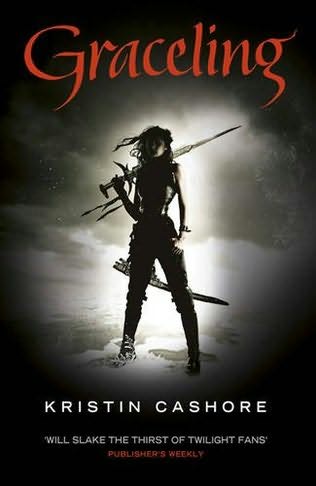
Review: Graceling by Kristin Cashore

book 2 for the Once Upon a Time III Challenge
genre: young adult fantasy
rating:5/5

Oh yes, this is a fun one. The story revolves around Katsa - a girl with ninja-like reflexes who has never been beaten in a fight and who can kill a man with her bare hands. She's got serious skills and this 'Grace' of hers makes her an amazing weapon. She has spent her life at the bidding of her arrogant uncle, the king, enforcing his word and handing out his kind of "justice." A chance encounter with an unknown man whose fighting skills nearly match her own flusters Katsa and is the start of an adventure that will involve more treachery and danger - and maybe even a chance to learn something even deeper about herself

I liked Katsa - I liked her spirit and her abilities, her awareness and the way her character was slowly and subtly refined throughout the book. She was a strong female protagonist but she had a lot to learn. The idea of having people with special powers to be exploited or appreciated was very intriguing and consistently played well into the plot. The romance was satisfyingly fresh and the relationships felt real. The pace was swift and I was surprised by things, even at the end. To be completely honest, sometimes the dialogue bordered on...not cheesy, just slightly unnatural. I was also a bit disappointed that she had such hostile views of marriage. But I am giving it five stars because I could not put the dang thing down and because I am going upstairs right now to read the prequel.

Friday, May 15, 2009

Review: An Edible History of Humanity by Tom Standage

book 1 of 5 for the Non-Fiction Five challenge
genre: non-fiction/food
rating: 4/5

This book isn't really about eating food. It's not about tasting food or cooking food. An Edible History of Humanity is about food's place in world history - the roles it has filled, the drama that has sometimes surrounded it and the absolute necessity for our world to deal with it on a daily basis.

We start at the beginning, learning about hunter-gatherers and the transition to more farming-based agriculture. Food is discussed as a major reason why the world started being explored by countries that could afford it - and how food has been used throughout the centuries as a way to separate the wealthy from the masses. I was amazed by how many different conflicts and events were somehow or another related to special foods or a lack of food or an abundance of food - and how often food was used as a weapon. Some of the information is anecdotal, some is downright scientific or straight from a history textbook. It all merges together in body of knowledge that was, for me, completely fascinating and utterly readable. But then again, this stuff really interests me. I always wanted to read around someone so I could talk about the things I was learning.

I appreciate that this was truly a world history - I learned about Africa, the spice islands, Europe and America, India and China. Often it was the interaction between countries and their foodstuffs that was discussed in the context of each nation's desire to have enough food to feed its population and at the same time to hopefully have enough left over to export. What a delicate balance, this feeding of a people. How intricate and essential food is to our daily living. It's interesting to look over history as a whole - to see how far we've come technologically and where we are headed. And yet, when you think about it - the vast majority what we eat, right now, was originally a seed in the ground, a seed that is the descendant of thousands of other seeds. How close we really are to where we started from.

Non-Fiction Five!


I've never tried this one, but based on the books I've got coming up, it looks like a good one :) It will certainly stretch me a bit, and that's a good thing.
The rules:
1. Read 5 non-fiction books during the months of May - September, 2009 (please link your reviews on Mister Linky each month; Mister Linky can be found each month on this blog)

2. Read at least one non-fiction book that is different from your other choices (i.e.: 4 memoirs and 1 self-help)


My tentative list:
1. An Edible History of Humanity by Tom Standage
2. Why Darwin Matters: The Case Against Intelligent Design by Michael Shermer
3. Gift from the Sea by Anne Morrow Lindbergh
4. Hold On To Your Kids: Why Parents Need to Matter More Than Peers by Gorden Neufeld
5. The Singing Creek Where the Willows Grow - The Mystical Nature Diary of Opal Whitely

I'm really excited!

Monday, May 11, 2009

Review: A Worthy Legacy by Tomi Akinyanmi

book 6 of 10 for the Orbis Terrarum 09 Challenge
genre: non-fiction/inspiration

Imagine: a village in Nigeria. A family has gathered around a beloved grandfather in his home as he uses his last moments to share with his wives, children and grandchildren all the wisdom he has gained through pondering and through experience. Tomi, this author of this book, is one of those beloved grandchildren and A Worthy Legacy is a collection she has made of those thoughts and inspirations that her grandfather gleaned from a long and full life.

I love how Tomi set up the story and my only complaint is that I wanted more about her life in Nigeria! She did a beautiful job describing some of the rituals and traditions that surround the ending of life. But, that wasn't her main point, as I understood after reading it. She wanted to put her grandfather's knowledge into the world's hands, to hopefully provide even just one person the strength to find renewed dignity or to choose to put their life on a better path.

What I am appreciating, now that I am letting his thoughts mull around in my mind, is that he and I, two completely different people who have led absolutely different lives on opposite sides of this planet - we believe the same things about how to live a good life. This elderly gentleman who grew up in a Nigerian village wanted to teach his children the same things that I want to teach mine. His simple words never startled me or surprised me - the writing is not lyrical or jubilant or complex. You merely come away from the book knowing that Tomi's grandfather left this life knowing what was worth caring about - and that if we read closely, we might be tempted to look for that same knowledge ourselves.

Sunday, May 10, 2009

20 Boy Summer by Sarah Ockler

genre: young adult romance
rating: 4/5

On Anna's 15th birthday, her deepest wish comes true. And if she can't tell her best friend Frankie (a girl) about it for a little while, that's okay, right? Life is bliss, with a side of guilt, until Anna and Frankie are blindsided by a tragedy that changes everything. One year later, the two girls head to California for vacation - to find new boys and have the best summer ever.

20 Boy Summer is about first loves and devastating loss. It's about relationships and about purposefully loosing one's virginity and all the drama and emotion that entails. I think that the author got teenage angst just right. Anna and Frankie's relationship felt unforced and natural - imperfect with some teenage selfishness and a lot of sarcasm.

Older teens, especially teens who have had to work through a serious loss, will really respond to this book. And while I personally don't advocate shedding one's virginity while in high school - and this book leaned too far towards the "it's a good idea" camp for me - I am very aware that it is a major issue to be dealt with and the book didn't get crude or glamorize it.

I cringed at their choices and I had a hard time believing that Anna and Frankie truly got away with some pretty crazy antics. It felt like authentic teenage drama and if you like young adult romance, you'll probably love this one, not only for the romance, but for the depth of feeling shown by the characters.

Saturday, May 9, 2009

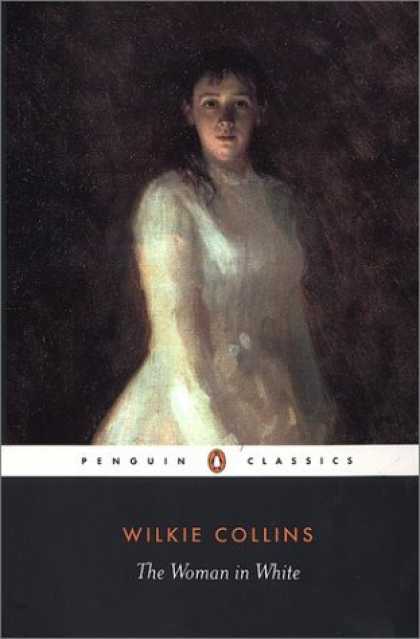
The Woman in White by Wilkie Collins

genre: mystery
rating: 4/5

Wilkie Collins, well done, friend. The first word that comes to mind when I describe this book to people is "sensational, " in the sense that it was written like a modern day television crime drama, daring us to NOT be shocked. Originally, the text was a serial novel in the mid 19th century, and it clearly shows: the Woman in White is one cliffhanger after another. I always found myself actually wondering, "What could that letter say?" or "What WAS the Count doing there anyway?"Despite the fact that it's a seriously long book (and it probably took me a good 150 pages to get truly into it) Collins certainly kept up the pace. Sometimes it felt a bit repetitive, but I excused it due to how it was originally published.

Within the book, many different narrators give their own "testimonial" of the events, so we are told the story from several points of view and never really sure if we can believe that what we are being told is all there is to know. First and foremost of our narrators, we have Walter, the traveling art teacher who first sees the Woman in White on an empty street outside of London. This chance meeting will take Walter from the epitome of happiness to the depths of despair and all the foreshadowing at the beginning was well placed, I thought. I wondered how things could be as tragic as he alluded they would be and MAN, was he right!

The writing was very accessible. I never got confused by the large number of characters or places. I really liked the relationship between the two main female characters, Laura and Marian, they were so lovingly dependent on each other. The evil characters were so deliciously evil and I appreciated that things did NOT turn out the way I'd imagined. Certainly there is treachery and insanity and graveyards and bad men who claim to be Chemists - it was like a wild ride through a Victorian soap opera. Tally-ho~!